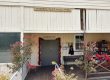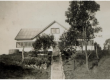


The origin of the name “Beehive Stores” in Australia is elusive. By the 1850s Beehive Stores could be found in many Australian country towns and cities as well as overseas.1 In the US they were a network of stores that acquired and sold products at bargain prices.2
While there is little evidence that the stores were part of a chain in Australia, the name was widely used. A “beehive” implies a busy place with small compartments – an apt description for a department store “always humming with business”.3
The brick Beehive Store in Taree was designed by architect Charles Assinder Harding after the previous wooden one burned down.4 Harding’s practice was based in Sydney and he was responsible for the design of many beautiful buildings including the Royal Aquarium Bondi,5 the Victoria Arcade,6 the Grand Central Coffee Palace7 and the Cape Byron Lighthouse.8 It is unclear why Harding designed the majestic Beehive Store but as previously discovered Taree, despite its rural location, attracted many high profile architects.
The construction of the Beehive was conducted by local tradesmen including contractor H W Alcorn who made and laid the bricks and also built the Exchange Hotel,9 Supervisor James H Stewart who built the current Royal Hotel and Connells Department Store10 and woodworker S Brewer who erected many schools in the region.11
Country and city expertise coming together to create an icon.
Author: Janine Roberts


References:
1 Sydney Gazette and New South Wales Advertiser, 2 April 1814, 1; SMH, 15 February 1845, 3.
2 https://missoulacurrent.com/bee-hive-stores-montana/
3 Albury Banner and Wodonga Express, 4 January 1895, 27.
4 Manning River Times, 28 March 1906, 2.
5 Maitland Mercury and Hunter River General Advertiser, 24 Feb 1887, 2; SMH, 29 Sep 1887, 11.
6 SMH, 23 March 1887, 10.
7 Daily Telegraph, 29 Dec 1888, 9.
8 Daily Telegraph, 2 Dec 1901, 6.
9 Wingham Chronicle Wed 6 May 1914 Pg 2.
10 Wingham Chronicle, 31 January 1906, 2; WC 28 March 1906, 3; WC, 26 August 1911, 6; various newspaper articles from 1898 – 1921.
11 Manning River Times, 5 October 1901, 4.